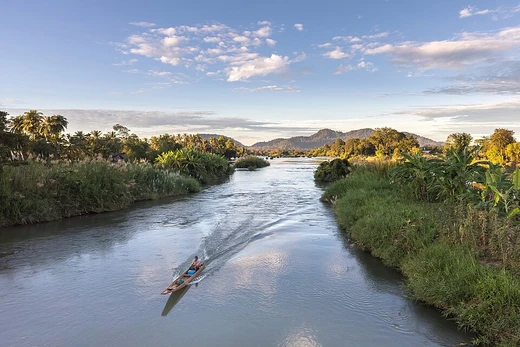
White Nile
Longer but less voluminous tributary of the Nile.

via Wikipedia: White Nile · see source
The White Nile is a river in North and East Africa. It is the less voluminous, but longer (and wider and shallower), of the two major tributaries of the Nile, the larger being the Blue Nile. The name 'White' comes from the clay sediment carried in the water which gives the water a pale color. In the strict meaning, 'White Nile' refers to the river formed at Lake No, at the confluence of the Bahr al Jabal and Bahr el Ghazal Rivers. In the wider sense, 'White Nile' refers to all the stretches of river draining from Lake Victoria through to the merger with the Blue Nile: the 'Victoria Nile' from Lake Victoria via Lake Kyoga to Lake Albert, then the 'Albert Nile' to the South Sudan border, and then the 'Mountain Nile' or 'Bahr-al-Jabal' down to Lake No. 'White Nile' may sometimes include the headwaters of Lake Victoria, the most remote of which being 3,700 km (2,300 mi) from the Blue Nile.
- length
- 3,700 km (2,300 mi) from the most remote headwaters of Lake Victoria to the Blue
- source
- Lake Victoria (via the Kagera River and its tributaries, with disputed most dist
- confluence
- Joins the Blue Nile at Khartoum, Sudan, to form the River Nile
- key tributaries
- Bahr al Jabal, Bahr el Ghazal, Sobat River
- navigable stretch
- From Lake Albert to Khartoum via the Jebel Aulia Dam
Lore & Background
The White Nile's headwaters begin with the Kagera River, which flows into Lake Victoria near the Tanzanian town of Bukoba. The Kagera is the longest feeder river for Lake Victoria, though sources do not agree on which is the longest tributary of the Kagera, and hence the most distant source of the Nile. The source can be considered either the Ruvyironza, which emerges in Bururi Province, Burundi (near Bukirasaz), or the Nyabarongo, which flows from Nyungwe Forest in Rwanda. These two feeder rivers meet near Rusumo Falls on the border between Rwanda and Tanzania. These waterfalls are known for an event on 28–29 April 1994, when 250,000 Rwandans crossed the bridge at Rusumo Falls into Ngara, Tanzania, in 24 hours, in what the United Nations High Commissioner for Refugees called 'the largest and fastest refugee exodus in modern times'. The Kagera forms part of the Rwanda–Tanzania and Tanzania–Uganda borders before flowing into Lake Victoria. From Lake Victoria, the river flows as the Victoria Nile through Uganda, passing over Bujagali Falls about 15 km downstream from Jinja, and through Lake Kyoga before reaching Lake Albert. At Murchison Falls, just before entering Lake Albert, the river is compressed into a passage just seven meters wide, marking its entry into the western branch of the East African Rift.
Reader's Guide
The White Nile is significant as the longer of the Nile's two main tributaries, providing a crucial waterway through Uganda, South Sudan, and Sudan. Its pale color, caused by clay sediment, distinguishes it from the Blue Nile. The river's course includes the vast Sudd swamp in South Sudan, which slows its flow, and the Sobat River tributary, which carries a large amount of sediment when in flood, adding greatly to the White Nile's pale color. Historically, the White Nile was central to the 1898 Fashoda Incident at Kodok, which marked an end to the Scramble for Africa. The White Nile is a navigable waterway from Lake Albert to Khartoum via the Jebel Aulia Dam, though only between Juba and Uganda requires the river upgrade or channel to make it navigable. During part of the year the rivers are navigable up to Gambela, Ethiopia, and Wau, South Sudan. The river also lends its name to the Sudanese state of White Nile, before joining the larger Blue Nile at Khartoum to form the River Nile. Its disputed source—either the Ruvyironza or Nyabarongo—reflects ongoing geographical uncertainty.
Did You Know?
- The name 'White Nile' comes from the clay sediment carried in the water, which gives the water a pale color.
- At Murchison Falls, the river is compressed into a passage just seven meters wide before entering Lake Albert.
- On 28–29 April 1994, 250,000 Rwandans crossed the bridge at Rusumo Falls into Tanzania in 24 hours, called 'the largest and fastest refugee exodus in modern times' by the UNHCR.
- The 1898 Fashoda Incident at Kodok marked an end to the Scramble for Africa.
- The Sobat River tributary carries a large amount of sediment when in flood, adding greatly to the White Nile's pale color.
Frequently Asked Questions
What is the White Nile?
The White Nile is a major river running through East and North Africa and one of the two principal tributaries feeding the Nile. It is the longer of the pair but carries noticeably less water volume than the Blue Nile.
Why is it called the "White" Nile?
The name refers to the pale clay sediment suspended in its current, which gives the water a light, milky hue. This visual distinction is what separates it from the darker Blue Nile.
Where does the White Nile start and where does it end?
Its most distant headwaters trace back to Lake Victoria through the Kagera River system, though the exact farthest source remains a matter of debate. The river ultimately meets the Blue Nile at Khartoum, Sudan, and the two together form the main Nile.
How long is the White Nile?
Stretching roughly 3,700 km (about 2,300 miles) from its farthest source at Lake Victoria to its junction with the Blue Nile, it outpaces the Blue Nile in length while trailing behind in water volume.
How does the White Nile compare to the Blue Nile?
The White Nile is longer, wider, and shallower, with a pale, clay-tinted current, whereas the Blue Nile is shorter but carries far greater volume and a darker color. They converge at Khartoum to create the Nile as we know it.
More in Rivers 1-16
Spotted an error? Know more?
This is a living reference — every entry is fact-audited, and reader corrections feed straight into our audit queue. Suggest an edit · See this site's audit record